Full Discharge Test
We isolate the normal power supply and verify that every emergency luminaire operates for its full rated duration (typically 3 hours) on battery power.
Keeping your premises compliant and your escape routes visible. Honest advice, thorough testing, and no unnecessary costs across Dorset, Hampshire, and Wiltshire.
We test, service, and maintain emergency lighting systems for businesses of all sizes - from small workshops and offices to warehouses, retail sites, and managed properties. Our team brings real operational fire safety experience. We know what works, what doesn't, and how to keep you compliant. Whether you need an annual full-duration discharge test, routine maintenance, or straightforward advice on system upgrades, we handle it. No overselling, no unnecessary costs.
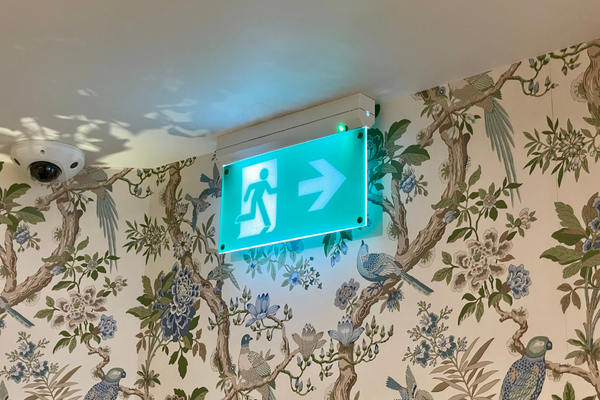
All testing and servicing is carried out in strict accordance with BS 5266-1:2025, the British Standard for emergency lighting. On an annual service we check:
We isolate the normal power supply and verify that every emergency luminaire operates for its full rated duration (typically 3 hours) on battery power.
We inspect all fittings for physical damage, discolouration, or dirt that could reduce light output, cleaning them where necessary.
We assess the condition of the backup batteries, identifying any units that fail to hold a charge or show signs of degradation.
We confirm that all illuminated exit signs are functioning and that the emergency lighting provides adequate lux levels along escape routes and over safety equipment.
We review your monthly testing records, update the service log, and provide a written compliance certificate for your files.
Not every failing light needs replacing, and we will always tell you honestly which route makes more sense. Replacing fittings unnecessarily costs you money. Relying on dead batteries puts you at risk.
If the luminaire housing is sound but the unit fails the duration test, replacing the internal battery pack or the lamp is usually the most cost-effective way to restore compliance.
We will recommend replacing the entire fitting when it is obsolete, severely degraded, or when upgrading to modern LED emergency lighting offers significant long-term savings on energy and maintenance costs.
Under the Regulatory Reform (Fire Safety) Order 2005, the Responsible Person must ensure that emergency routes and exits requiring illumination are provided with emergency lighting of adequate intensity in the case of failure of their normal lighting.
Annual testing is a legal requirement. British Standard 5266-1 specifies that emergency lighting systems must undergo a full-duration discharge test annually, conducted by a competent person.
Monthly functional checks are your responsibility. In addition to the annual service, the Responsible Person must carry out a short functional test every month to ensure all luminaires illuminate when the mains power is simulated to fail. This must be recorded.
The consequences of non-compliance are serious. Failing to maintain emergency lighting can plunge escape routes into darkness during a power failure or fire, causing panic and hindering evacuation. This can result in enforcement action and invalidate your insurance.
We take the administration out of compliance. We track your service schedule, remind you when your annual test is due, and provide all the documentation you need to demonstrate that your premises are properly maintained.
Emergency lighting servicing is a fixed price for up to 10 lights, then priced per light for larger systems.
| 1 to 10 lights | £95 fixed |
| 11 to 20 lights | £9.00 per light |
| 21 to 40 lights | £8.00 per light |
| 41 to 60 lights | £7.50 per light |
| 61 or more lights | £7.00 per light |
Prices exclude VAT. Full report and certificate included.
No call-out fee.
Limited companies can spread the cost over 3 or 12 months.
Founder and Director, 34 years with the Dorset fire service, FIA member
Founder and Director of Abbey Fire Safety. 34 years with the Dorset fire service and a member of the Fire Industry Association (FIA).
View Darren's LinkedInWe work with businesses and property managers across the South. If you're responsible for fire safety on a premises, we can help.
Can't find what you're looking for? We're happy to help.
Our Fractional Fire Safety Officer looks after this and everything else that keeps you compliant, for one monthly fee. From £100 a month for a single site.
Six-monthly fire alarm servicing to BS 5839-1:2025: panel, batteries, detectors and call points tested and logbook updated.
Learn moreSix-monthly fire door inspections: seals, hinges, closers and 3mm gaps checked, with honest repair or replace advice.
Learn moreA written, prioritised assessment of your premises and the steps needed to stay compliant under the Fire Safety Order 2005.
Learn moreGet expert fire safety support with over 30 years of experience across Dorset, Wiltshire, Hampshire and beyond. You'll receive a free site survey and only ever be recommended what you genuinely need. No overselling, no unnecessary costs.